

Exporting goods isn’t just about finding a buyer; it’s about making sure you actually get paid across borders, oceans, and shifting political landscapes. For Indian exporters, the ECGC (Export Credit Guarantee Corporation of India Ltd.) is the ultimate safety net.
Thank you for reading this post, don't forget to subscribe!Here is a comprehensive guide to understanding ECGC and how it empowers Indian trade.
What is ECGC?
Established in 1957, ECGC is a specialized government-owned Export Credit Agency (ECA) under the Ministry of Commerce and Industry. Its primary mission is to promote Indian exports by covering the financial risks of selling on credit to foreign buyers.
Think of ECGC as a hybrid between an insurance company and a financial guarantor. It protects you if your foreign buyer goes bankrupt or if a war in their country prevents them from sending you money.
Core Functions of ECGC
ECGC operates on three main fronts to ensure the export cycle remains fluid:
- Risk Protection: It provides credit insurance to exporters against “Commercial” and “Political” risks.
- Guarantees to Banks: It provides guarantees to Indian banks so they feel confident lending money (pre-shipment or post-shipment) to exporters.
- Market Intelligence: ECGC maintains a massive database on the creditworthiness of overseas buyers and the risk levels of different countries.
What Risks are Covered?
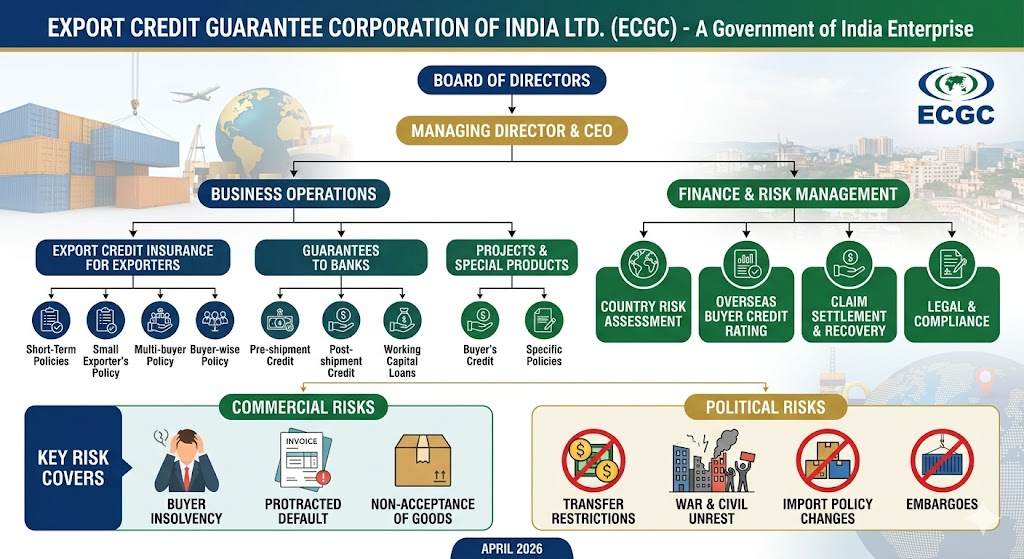
1. Commercial Risks
- Insolvency: The buyer goes bankrupt.
- Protracted Default: The buyer fails to pay for the goods within a specified period (usually 4 months) after the due date.
- Non-acceptance: The buyer refuses to accept the goods without a valid reason (subject to certain conditions).
2. Political Risks
- Transfer Restrictions: The buyer has the money, but their government restricts the conversion or transfer of local currency into Foreign Exchange.
- War/Civil Unrest: Outbreak of war, revolution, or civil disturbances in the buyer’s country.
- Import Policy Changes: New laws in the buyer’s country that suddenly ban the import of your goods.
What is NOT covered?
ECGC does not cover risks that are within the exporter’s control, such as:
- Disputes over the quality of goods.
- Failure of the exporter to obtain necessary export licenses.
- Exchange rate fluctuations (currency risk).
Popular ECGC Policies & Products
ECGC offers a variety of products tailored to different business sizes and needs:
| Policy Type | Best For… | Key Feature |
| Shipment Comprehensive Risks (SCR) | Established exporters with regular shipments. | Covers all shipments for 12–24 months. |
| Small Exporter’s Policy | New or small-scale exporters (turnover < ₹5 Crore). | Lower premiums and simplified procedures. |
| Single Buyer Exposure Policy | High-value orders from one specific buyer. | Covers risk for a single large client. |
| Buyer-wise Policy | Exporters dealing with a few specific clients. | Flexible coverage based on individual buyer credit limits. |
Recent 2026 Update: The RELIEF Framework
In response to geopolitical disruptions in the Gulf and West Asia maritime corridors (early 2026), the Government of India launched the RELIEF Intervention through ECGC.
- Enhanced Cover: Compensation for war/political risks was boosted to 95%–100% (up from the usual 80%–90%).
- Premium Stability: Premiums for shipments to affected regions like the UAE, Saudi Arabia, and Israel were frozen at pre-disruption rates.
- Logistics Support: Assistance for MSMEs to offset extraordinary freight and insurance surcharges.
How to Get Started with ECGC
- Application: Submit a proposal form detailing your export turnover and the countries you deal with.
- Buyer Credit Limit: For every buyer you want to insure, you must apply for a “Credit Limit.” ECGC will check the buyer’s history and tell you how much risk they are willing to cover.
- Premium Payment: Pay the premium based on the country’s risk rating and the credit period.
- Declaration: Regularly declare your shipments to ECGC to keep the cover active.
Summary
For an Indian exporter, ECGC is not just an insurance provider—it’s a strategic partner. It allows you to offer competitive credit terms to foreign buyers, which is often the deciding factor in winning a contract, all while knowing your capital is protected.