

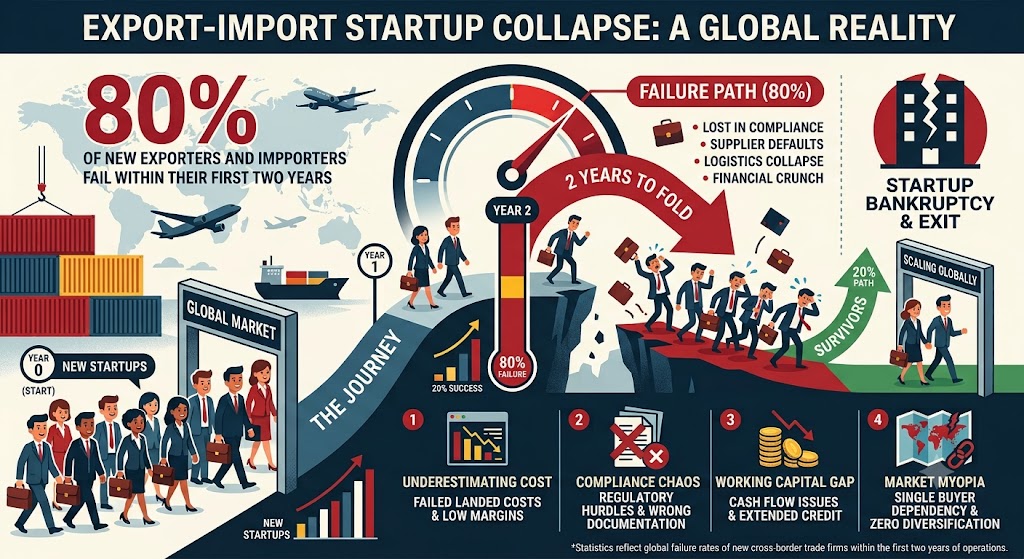
Stepping into international trade is highly rewarding, but the statistics are unforgiving: nearly 80% of new exporters and importers fail within their first two years.
Thank you for reading this post, don't forget to subscribe!While many assume the biggest barrier is simply “finding a buyer or supplier,” the true root causes of failure usually happen behind the scenes. In global trade, small domestic oversights become catastrophic international liabilities.
The major root causes that trip up new first-generation traders include:
1. Underestimating “Landed Cost” & Wrong Pricing
New traders often calculate their margins based on standard formulas: Cost of Goods + Freight = Price. In international trade, this is a fast track to a cash crunch.
They frequently fail to calculate the true landed cost—the total price of a product once it arrives at the buyer’s doorstep.
- The Trap: Forgetting to factor in terminal handling charges (THC), custom house agent (CHA) fees, inspection charges, phytosanitary or fumigation costs, marine insurance, and currency fluctuation buffers.
- The Result: A shipment is completed, but the hidden costs completely eat the profit margin, or worse, the trader loses money on the very first deal.
2. Compliance Ignorance & Destination Blindness
Many new entrants pick a product based on domestic abundance but fail to research the import regulations of the destination country. They assume that because a product leaves the home port legally, it will enter the destination port just as easily.
- The Trap: Every country has unique, rigid quality barriers. For example, exporting agricultural goods to the EU, US, or Middle East requires strict compliance with maximum residue limits (MRLs) for pesticides, heavy metals, specific labeling standards, and precise Certificates of Origin.
- The Result: The cargo arrives at the destination port, fails inspection, and is either seized, destroyed, or ordered to be shipped back at the exporter’s expense. This single mistake can bankrupt a young LLP.
3. Working Capital Exhaustion (The Cycle Gap)
International trade requires deep breath control when it comes to cash flow. New traders often budget only for the manufacturing and shipping of their first container, ignoring the vast timeline gap.
- The Trap: If you source goods on an advance or cash basis from local suppliers but agree to a 60-to-90-day credit term or a deferred Letter of Credit (LC) with an international buyer, your capital is locked up.
- The Result: Even if the deal is highly profitable on paper, the business runs out of cash to pay for overheads, logistics partners, or the next order. Without a 6-month operational buffer, the business stalls before it can scale.
4. Trusting Unvetted Partners & Skipping Risk Insurance
In the eagerness to close the monumental “first order,” new exporters and importers often overlook strict background verification.
- The Trap: Sending shipments on open terms or weak payment structures to buyers met online without checking their credentials, or importing from unvetted overseas suppliers who compromise on quality or ghost after receiving an advance. Furthermore, many skip Credit Insurance (like ECGC in India) or Marine Cargo Insurance, viewing them as optional expenses.
- The Result: If a buyer defaults or cargo gets damaged at sea, the loss is 100% fatal to the business.
5. Single-Market & Single-Buyer Dependency
When a new exporter lands that first major, recurring international client, it feels like an absolute victory. However, over-reliance on one client or one country is a structural vulnerability.
- The Trap: Putting all operational focus into serving one buyer. If that buyer faces a financial crisis, changes their sourcing strategy, or if geopolitical conflicts disrupt that specific shipping route, the exporter’s entire pipeline vanishes overnight.
- The Result: The business lacks the agility or the diversified buyer network to pivot to other markets, leading to sudden operational collapse.
The Takeaway: Successful international trade isn’t just about selling; it’s about meticulous risk management and flawless documentation. The traders who survive are those who treat compliance and costing as a science, map out their cash flow cycles aggressively, and insure their risks before the container ever leaves the yard.
specific strategies to mitigate payment and non-payment risks in international trade
Filing a default report and a subsequent claim with ECGC requires strict adherence to specific regulatory timelines. In international credit insurance, missing a deadline by even a single day can legally invalidate your entire coverage.
If your overseas buyer misses their payment due date, you must follow this exact step-by-step process and timeline to protect your capital.
The Master Timeline at a Glance
The countdown starts the exact day after the invoice payment due date passes.
[ Due Date Passes ] ──(Max 30 Days)──> [ File Monthly Overdue Declaration ]
                                                  │
                                              (Max 4 Months / 120 Days)
                                                  │
                                                  ▼
                                       [ File Report of Default ]
                                                  │
                                              (Wait 4 Months "Protracted Default")
                                                  │
                                                  ▼
                                       [ File Formal Claim Form ]
Detailed Step-by-Step Process
Step 1: Submit the Monthly Overdue Declaration
Before filing a formal default, you are contractually obligated to inform ECGC of any bill that has remained unpaid past its due date.
- The Deadline: This must be reported by the 15th day of the subsequent month following the month in which the bill became overdue.
- How to do it: Log in to the ECGC Customer Portal and update your monthly declaration to mark the specific shipment bill as “unpaid/overdue.”
Step 2: Formal “Reporting of Default” (Critical Window)
If your initial payment follow-ups fail and the buyer still hasn’t paid, you must formally lodge a Report of Default via the portal.
- The Deadline: This must be submitted within 4 months (120 days) from the original due date of the bill (or from the extended due date, if ECGC explicitly approved an extension in writing beforehand).
- Why it matters: Failing to file the Report of Default within 4 months is the number one reason new exporters lose their insurance eligibility.
Step 3: The “Protracted Default” Waiting Period
Once the Report of Default is registered, ECGC enforces a mandatory 4-month waiting period from the due date of the invoice.
- The Logic: This is called the “protracted default” period. It gives ECGC’s international network time to contact the buyer, and gives you time to pursue amicable recovery or intercept/halt any additional cargo.
- Your Duty: You cannot sit idle. You must document your “loss minimization” efforts—such as legal notices, formal demand emails, or involving the local Indian Embassy in the destination country.
Step 4: Filing the Formal Claim
Once the 4-month waiting period expires and the buyer still has not paid (or if the buyer is officially declared insolvent earlier), you can formally lodge your insurance claim.
- The Deadline: The formal claim must be filed within 6 months from the date you filed the Report of Default.
- Maximum Ceiling: Under no circumstances can a claim be filed later than 360 days from the original due date of the bill.
Documents You Must Prepare
When you submit the final claim on the portal, ECGC requires an airtight paper trail. Ensure you have these ready:
- Core Trade Documents: The original Export Contract/Purchase Order, Commercial Invoice, Packing List, and the Onboard Bill of Lading (B/L) or Airway Bill.
- Regulatory Proofs: The Shipping Bill copy, the bank-stamped FIRT (Foreign Inward Remittance Thruway/Advice) or bank declarations showing zero realization.
- The Correspondence Trail: Copies of all emails, letters, and WhatsApp logs showing your clear demands for payment and the buyer’s excuses, defaults, or non-responsiveness.
- Policy Compliance: Proof of your approved buyer credit limit letter and your monthly premium payment receipts matching that specific shipment.
⚠️ Geopolitical Exception Note (2026): If your default is caused by political conflict or shipping disruptions in volatile regions (such as recent Red Sea or Middle Eastern maritime stress), check if your shipment falls under the RELIEF Framework. For specific windows, the Government of India increases ECGC coverage up to 95% to 100% for political/war risks and streamlines claims digitally through a dedicated portal link.